
About the piece
It belongs to the 25 Easy and Progressive Studies Op. 100, published in 1851 and still used in music schools all over the world.
The right hand runs in groups of five notes while the left answers with staccato chords; then the roles are swapped.
How to practise it
- The five-note groups use the five fingers, no thumb crossings: work on evenness.
- The left-hand staccato chords must be short and light.
- When the melody moves to the left hand, try to play it as clearly as the right.
- Speed up gradually: this study shines when it is lively.
Free sheet music
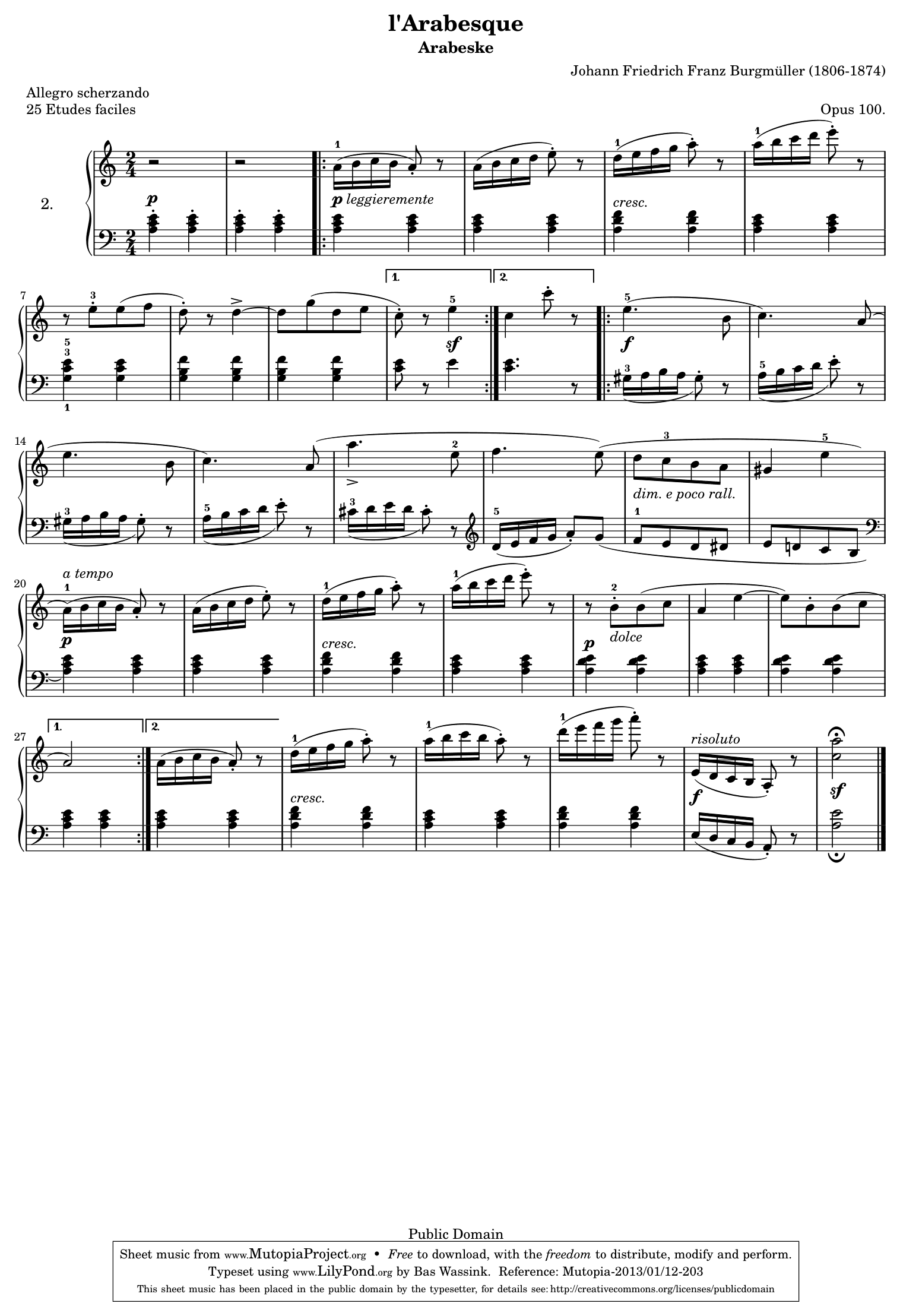
First page. Complete sheet music (PDF) on the Mutopia Project (public domain, edition by Bas Wassink); in the Piano Learning app you read it two pages side by side while you play.
Frequently asked questions
Is it suitable for beginners?
Yes, after about a year of study: it is written exactly for that level.
What are Burgmüller's 25 studies?
Short pieces, each with its own title and character, written to build technique while having fun.