
About the piece
Satie composed it in 1890. The score has no bar lines and no time signature, and instead of the usual Italian terms it carries poetic, ironic instructions in French.
The left hand alternates a bass note and a chord at a steady pace; the right hand draws a melody full of ornaments and unusual intervals.
How to practise it
- Left hand alone: bass–chord, always the same, like a slow clock.
- The melody has small fast groups: play them lightly, almost brushed.
- Without bar lines, count in groups of notes: the video shows the durations clearly.
- Keep a slow, steady pace: the charm is in the calm.
Free sheet music
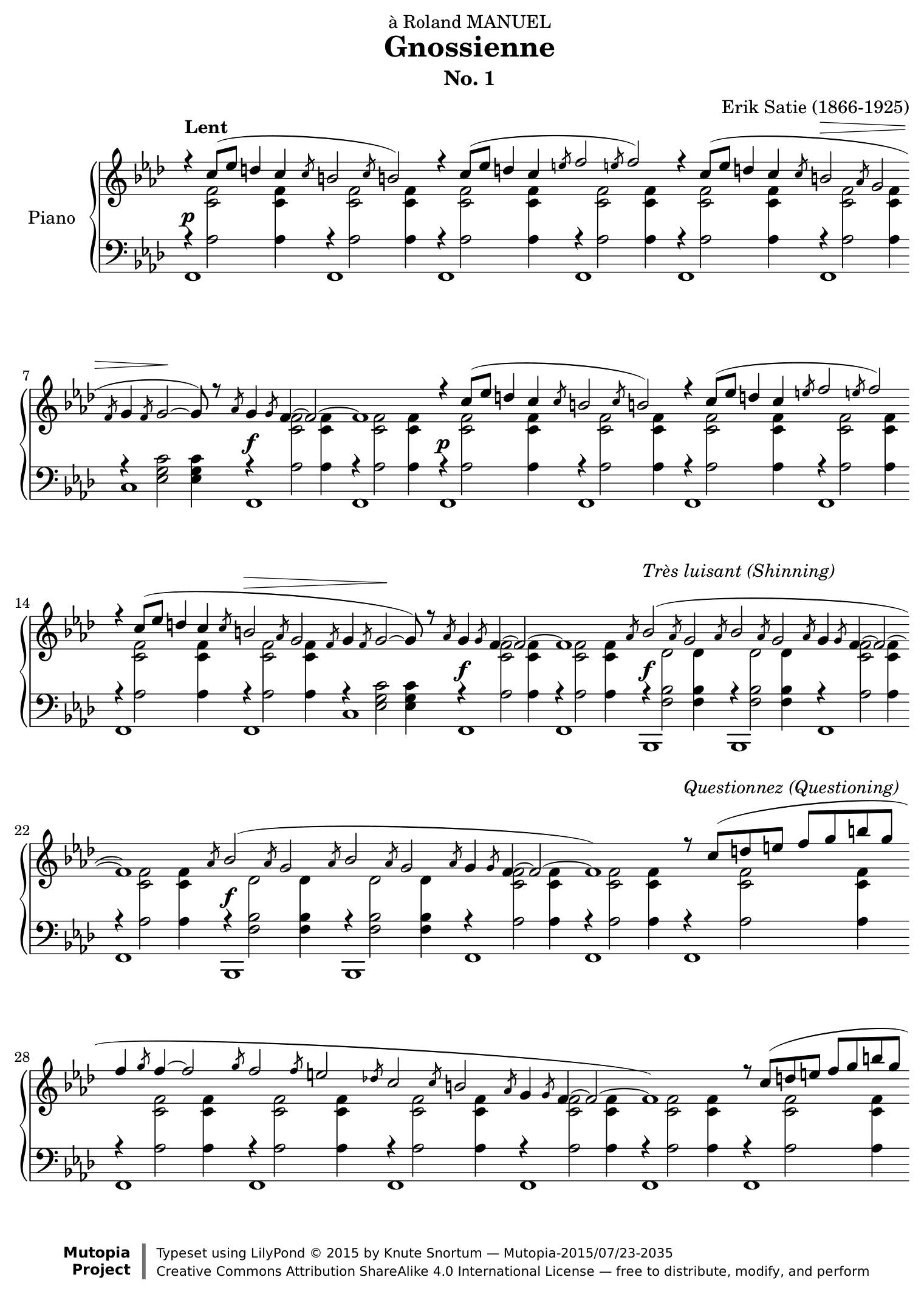
First page. Complete sheet music (PDF) on the Mutopia Project (CC BY-SA 4.0, edition by Knute Snortum); in the Piano Learning app you read it two pages side by side while you play.
Frequently asked questions
What does “gnossienne” mean?
It is a word invented by Satie; it probably refers to Knossos, the ancient city on Crete.
Is it hard?
No, it is approachable: slow, with a simple left hand. The ornaments need a little practice.