
About the piece
Chopin wrote it in his early twenties and published it in 1832 with the other two nocturnes of Op. 9, dedicated to Marie Pleyel. His model was John Field's nocturne, which he turned into something far richer.
The melody returns several times, more ornamented each time; the left hand, in 12/8, alternates a bass note and a chord with wide leaps.
How to practise it
- Left hand alone: bass and chord must be connected with the pedal, without bumps.
- The melody without ornaments first: sing it, then add the ornaments one at a time.
- The fast ornament notes are not counted rigidly: they slip over the left hand, which stays steady.
- Use reduced speed for the last, most florid passages.
Free sheet music
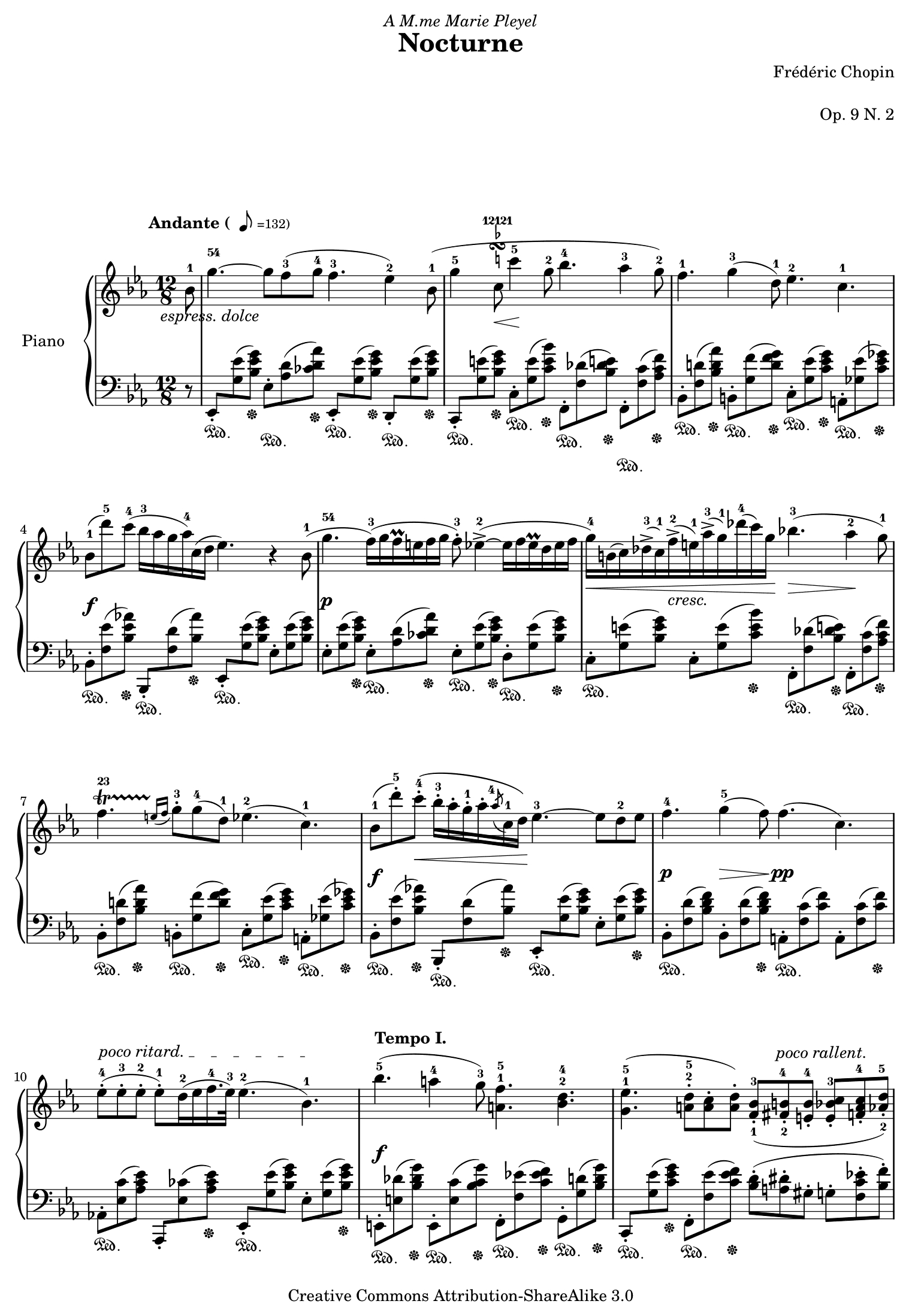
First page. Complete sheet music (PDF) on the Mutopia Project (CC BY-SA 3.0, edition by Renato Biolcati Rinaldi); in the Piano Learning app you read it two pages side by side while you play.
Frequently asked questions
What level do I need?
Upper intermediate: the melody notes are simple, but the ornaments and the rubato take experience.
Why is it called a nocturne?
It is a calm, lyrical piece meant for the mood of the evening; the genre was invented by the Irish composer John Field.