
About the piece
Für Elise is a bagatelle in A minor that Beethoven wrote in 1810 and never published: it was printed only in 1867, forty years after his death. Nobody knows for sure who “Elise” was; a much-discussed theory is that the name is a misreading of “Therese”, his pupil Therese Malfatti.
It is a small rondo: the famous theme comes back three times, alternating with two different episodes, a calm one in a major key and a more restless one with a repeated note in the bass.
How to practise it
- The theme alone, right hand. Keep the E–D♯ oscillation light and try not to look at the keys. It is the part everybody knows, so learning it well pays off immediately.
- Add the left hand. The left-hand arpeggios fit between the right-hand notes: the hands almost never play together, which makes it easier.
- The middle episodes come later: they need more independence between the hands and a quick scale up the keyboard.
- Playing at 50–60% without mistakes is worth more than playing fast with errors. Then speed up a little at a time.
Free sheet music
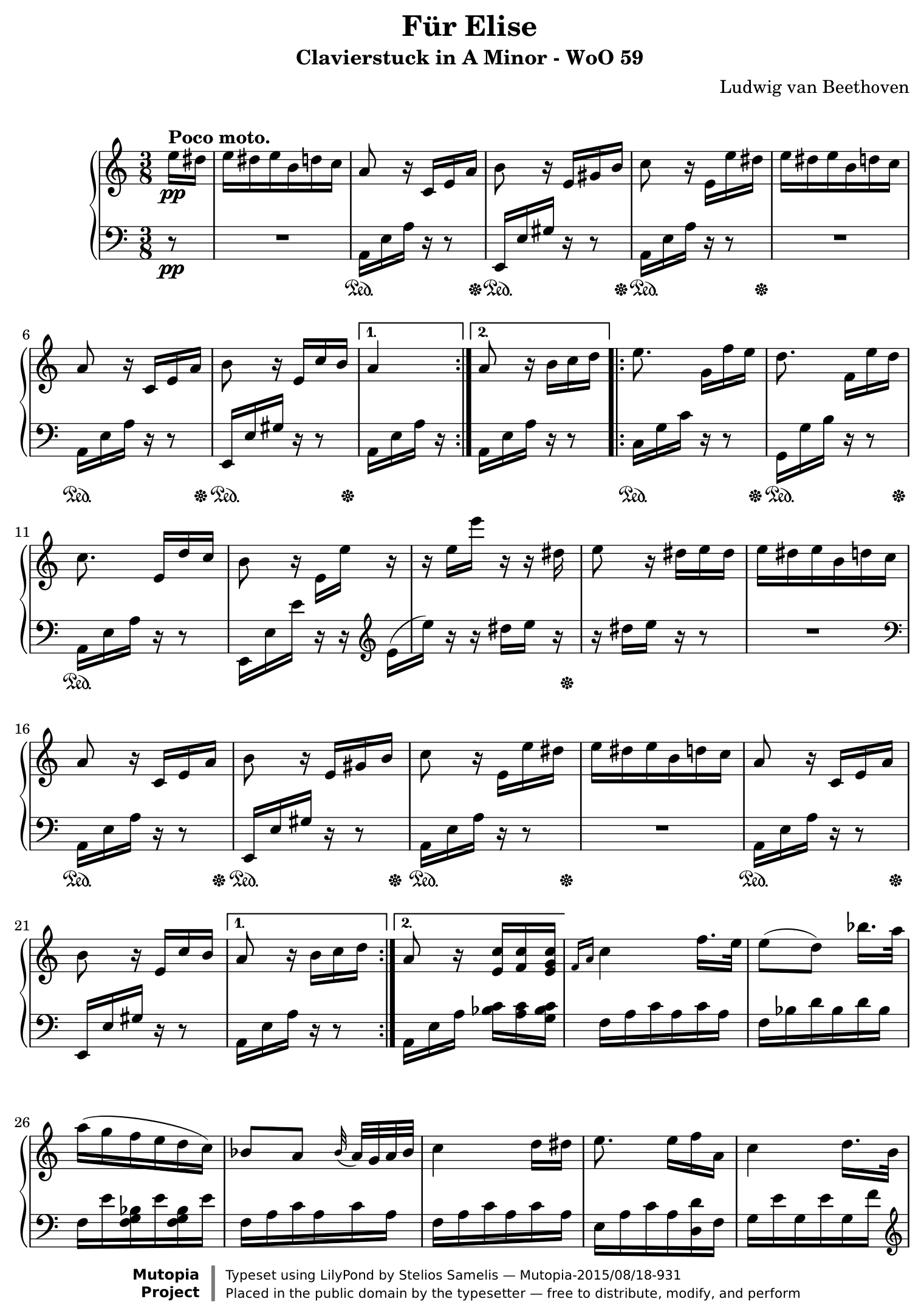
First page. Complete sheet music (PDF) on the Mutopia Project (public domain, edition by Stelios Samelis); in the Piano Learning app you read it two pages side by side while you play.
Frequently asked questions
Is Für Elise hard for beginners?
The main theme is within reach after a few months of lessons. The middle episodes are intermediate: many people learn the theme first, and that is a great goal.
Can I learn it without reading music?
Yes: with falling notes you see which key to press and when. Keeping the score next to you will help you learn to read music over time.