Composers › Giuseppe Verdi
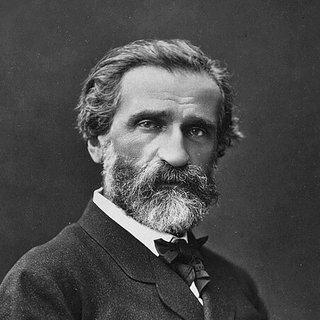
Giuseppe Verdi
Italy's best-loved opera composer: his melodies have become popular songs all over the world.
Life
He was born in Le Roncole, near Busseto (Parma), the son of an innkeeper. He learned to play the village church organ and, thanks to the support of a Busseto merchant, Antonio Barezzi, was able to study in Milan.
In 1832 he was not admitted to the Milan Conservatory, which today bears his name. After difficult years, success came in 1842 with Nabucco and the chorus “Va, pensiero”.
Masterpieces followed, such as Rigoletto, Il trovatore, La traviata, Aida, Otello and Falstaff. He died in Milan in 1901: when his body was moved to its final resting place, a large choir conducted by Arturo Toscanini sang “Va, pensiero” before a huge crowd.
Portrait: Ferdinand Mulnier (c. 1872), public domain, from Wikimedia Commons.

Curiosities
- La traviata, today one of the most performed operas in the world, was a failure at its premiere at La Fenice in Venice in 1853.
- The “Brindisi” (“Libiamo ne' lieti calici”) is the drinking song of the first act, in waltz time.
- He founded the Rest Home for Musicians in Milan, where he is buried, and left it the royalties of his operas.
At the piano
- Think of a singer's voice: the melody must breathe at the end of every phrase.
- The Brindisi is in three beats: a light accent on the first, the other two softer.
- Play it with energy and joy, it is a party.
Pieces to learn 1 piece

Learn it note by note with Piano Learning
With “Wait for the note” the piece stops until you play the right key, on your phone or on your own piano (the app listens). Hands separately, speed from 10%, sheet music always in front of you.
Get it free on Google Play Free like La Campanella, the Turkish March, Jingle Bells and Frère Jacques. Hundreds of other pieces with one single purchase, no subscription.